Court Confirmation "May Be Required": Two Ways LA Probate Listings Get It Wrong
43% of LA probate listings we reviewed promised no court. Most of the rest said nothing. Only 4% said "may be required." Both mistakes hurt the sale.
Yes or no: on the day a Los Angeles probate listing goes live, can anyone promise the sale won't need court confirmation?
No. Second question: should a full authority listing leave buyers thinking the sale is headed to court?
Also no. Yet when I reviewed two years of closed probate listings on TheMLS, most of them got one of those two wrong. Only 4% got it right.
Here are the two problems, what the data shows, and the wording I recommend instead. The fix is already in the Probate Listing Addendum.
What two years of LA probate listings say
I pulled every Los Angeles County residential listing on TheMLS that closed between October 18, 2024 and October 18, 2026 with the Probate box checked. That came to 618 listings. I read the public remarks, agent remarks and Disclosure field on each one, then matched them against the LA probate court confirmation-of-sale hearings I track.
Here's how the 618 break down:
- 268 listings (43.4%) told buyers court confirmation wasn't needed. That's Problem 1.
- About 325 listings (roughly 53%) said nothing about court confirmation in the remarks. That's Problem 2.
- Only 25 listings (4.0%) used the correct wording: "court confirmation may be required."
On top of that, 247 listings had the MLS Court Approval field set to Yes. Since a full authority listing can only select No in that field, a Yes generally signals limited authority.
Problem 1: Not protecting the client and the attorney
The first problem is promising something no one can promise. Of the 268 listings that negated court confirmation:
- 205 said it flatly in the remarks: "no court confirmation required," "not subject to court confirmation," and similar.
- 29 hedged with wording like "court confirmation may not be required" or "may or may not require court confirmation." That still tells buyers there's no court.
- 34 said it only through the "Court Approval Not Required" checkbox in the Disclosure field. In all, 118 listings (19.1%) had that box checked.
- 12 contradicted themselves: the Court Approval field said Yes, while the remarks or Disclosure field said court confirmation wasn't needed (11 listings) or might not be (1).
Full authority under the Independent Administration of Estates Act (IAEA) is valuable. It lets the personal representative sell without a court hearing by giving a Notice of Proposed Action to heirs and other interested persons. But full authority is not a guarantee. A full authority sale may still go to court if:
- An heir or other interested person objects to the Notice of Proposed Action.
- The court restricts or revokes the personal representative's authority while the case is open.
- The personal representative and the estate's attorney decide a confirmation hearing is the safer path.
When that happens and the MLS said "no court," nobody at the table was protected. The buyer made the deposit, locked a loan and planned a move around a promise. The estate gets a surprised buyer who may cancel or renegotiate. The attorney gets a sale that falls apart in the middle of the case. And the listing agent and brokerage own a statement that turned out to be wrong. Then there is the possibility of buyers suing for damages for lack of performance and sellers suing for negligence in not providing the proper disclosures.
One estate sale, three court hearings
One estate sale in Los Angeles County shows how far apart the remarks and reality can get. The listing's public remarks said: "NO Court Confirmation is required."
The court records tell a different story. On that case, I count three separate confirmation-of-sale hearing dates over about four months, each tied to its own petition to confirm the sale. The first two involved an earlier buyer's contract. At the third, a new buyer's contract went to hearing and a bid was made in open court. The sale didn't close until roughly six months after that third hearing.
It wasn't the only one. At least 9 sales in my data went to a confirmation-of-sale hearing even though the listing said court confirmation wasn't needed (or, in one case, might not be): 4 among the 618 TheMLS listings and 5 more from other MLSs. In two of them, the same remarks that said "no court confirmation" also mentioned the court date. Because I only see the hearings I track, 9 is a floor, not a ceiling.
Here is the bigger picture. Of the same 618 listings, 202 went to a confirmation hearing on the LA County probate calendar I track. 10 of those 202, about 1 in 20, were listed with Court Approval set to No, the setting a full authority listing has to use. The three-hearing sale above is one of them. Only 1 of the 10 said "may be required." 4 told buyers there was no court, 3 mentioned a court date or overbid, and 2 said nothing. Not one said "full authority."
Some will say 5% is low. It is not. If I ONLY crashed my car 5% of the time, it would be dangerous. When the MLS field says No, the remarks are the only place to protect the client and the attorney: "Full authority; court confirmation may be required."
Problem 2: Scaring off buyers
The second problem runs the other way. About 325 listings said nothing about court confirmation in the remarks.
Here's why that hurts. When a buyer or their agent sees "probate," the default assumption is that the sale has to go to court: a long escrow, a hearing, and overbids in open court. Some buyers skip probate listings for that reason. Others write a lower offer to make up for the wait.
The MLS doesn't fix this on its own. In the Court Approval field, a full authority listing can only select No. You can't choose Yes with full authority, and there is no way in that field to say "may be required." So the field alone doesn't tell buyers the seller has full authority, or that a hearing is still possible. That has to go in the remarks. When it isn't there, the estate's best selling point stays hidden, and buyers fall back on the default assumption that the sale is headed to court.
And full authority is the usual case. In 2023, I subscribed to commercial probate data covering every listed probate in LA County, downloaded it and sorted it. About 90% of those listed probates were full authority. In my experience, most full authority sales close without ever needing a court confirmation hearing.
So "may be required" is still the correct term for full authority. It isn't a warning sign, just the proper wording. But a listing that says only "probate," with nothing about the seller's authority, leaves buyers assuming the worst, and the estate may get fewer offers and lower prices because of it.
The fix: follow the Probate Listing Addendum
Both problems have the same fix, and it's already in the paperwork. Paragraph 3 of the C.A.R. Probate Listing Addendum and Advisory (PLA), signed by the seller and the listing broker, reads word for word: "3. Court confirmation of the sale ☐ is required (limited authority), ☐ may be required (full authority)." That gives two choices:
- Limited authority: court confirmation "is required."
- Full authority: court confirmation "may be required."
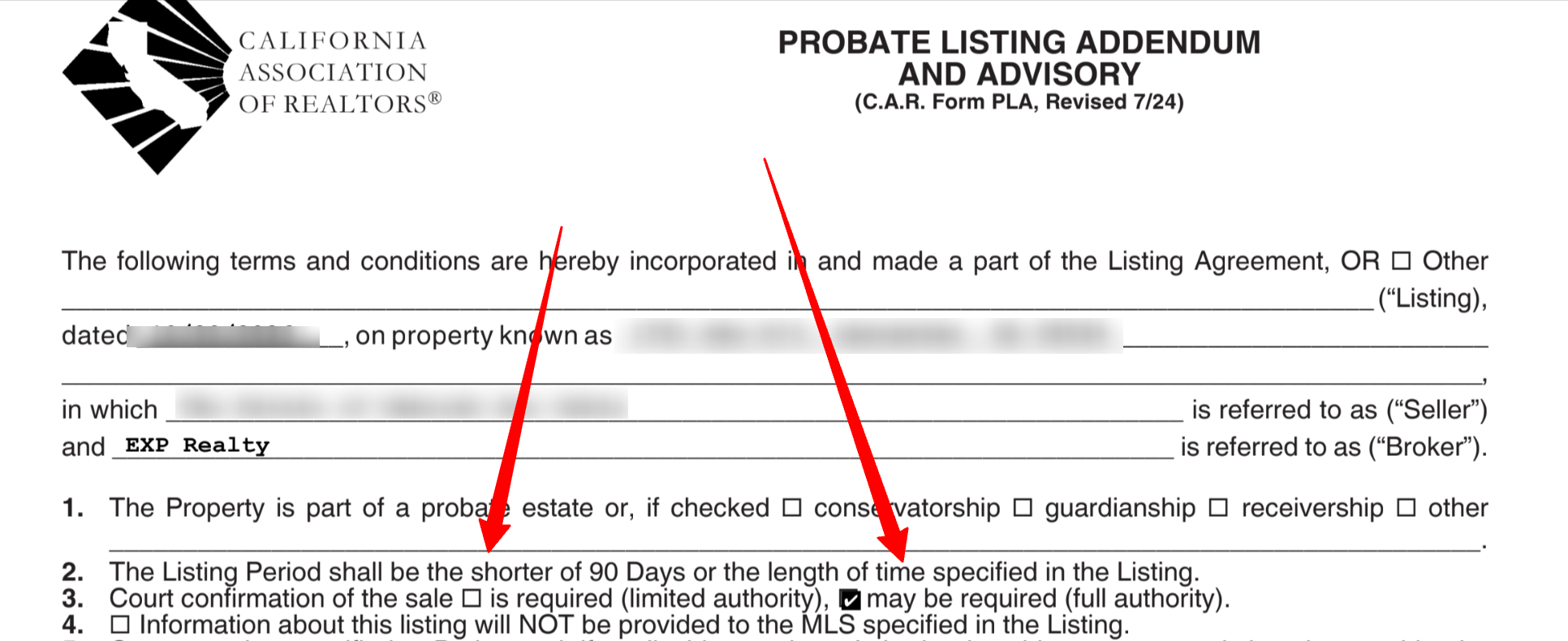
There is no third choice for "not required." With full authority, the listing should say clearly that the seller has full authority, use "may be required," and explain that most full authority sales close without going to court.
The buyer's paperwork matches. The C.A.R. probate purchase addendum (form PA-PA) gives two choices: court confirmation required, or undetermined at the time of the offer. There is no box for "not required." Picture an estate with several heirs. The notice goes out and a brother, sister or cousin says, "That's too cheap. Let's go to court." The form plans for that: if court confirmation becomes required, the buyer has 3 days to cancel and get the deposit back.
What agents should write instead
Here is sample language to start from. Have the estate's attorney review it for your case.
Full authority, public remarks: "Probate sale. Seller has full authority under the Independent Administration of Estates Act (IAEA). Court confirmation may be required, but most full authority sales close without a court hearing."
Full authority, agent remarks: "Administrator/executor has full IAEA authority. Court confirmation may be required if an interested person objects to the Notice of Proposed Action or the court requires a hearing; this can't be determined at listing. If a hearing is required, the sale is subject to overbid and the timeline may change. Please call listing agent with any questions."
Limited authority, public remarks: "Probate sale with limited authority. Court confirmation is required, and the sale is subject to overbid at the court confirmation hearing."
MLS fields: The Court Approval field is Yes or No. Limited authority is Yes. Full authority can only be No; you can't select Yes with full authority. That limitation is exactly why the explanation has to go in the remarks. Put "Full authority; court confirmation may be required" in both the public remarks and the agent (private) remarks. Don't check "Court Approval Not Required."
And skip "not required" and "may not be required." Neither one is a choice on the PLA.
An industry habit, not a few bad actors
This isn't a call-out, and I won't name anyone. The 268 "no court" listings came from more than 150 different listing agents. The habit reaches the top of the business: one of the most active probate listing agents in LA had 39 of these listings, out of 55 probate listings in the data. Another had 23 out of 26. Even two licensees who are also attorneys representing clients used the "no court" wording.
And to be fair, that includes some of my own listings. That was my error. I've changed my wording, and I'm making sure it doesn't happen again.
It's fixable. The single most active probate listing agent in the data had 101 probate listings, and only 6 used the correct wording.
What I do in my own listings
In my full authority listings, I state that the seller has full authority and that court confirmation may be required, and I explain that most full authority sales close without a hearing. I also add a line to the agent remarks inviting agents to contact me with any questions. Probate transactions are what I do, and a quick call before an offer is written can save everyone weeks of confusion later.
I explain why the wording says "may be required" in a video on my YouTube channel, and I link it in my listing agent remarks. If you'd rather watch than read, start here:
Watch: What Does "Court Confirmation May Be Required" Mean? Is It Required or Not?
How I counted
These counts come from wording matches in closed TheMLS listings, spot-checked by hand. A few edge cases may be misread. Some listings with the Probate box checked are really trust sales. Because a full authority listing can only select No in the Court Approval field, a Yes generally points to limited authority. "Hearing on file" covers only the LA probate confirmation-of-sale records I track, so the real number of listings proven wrong is likely higher. The 90% full authority figure comes from my 2023 review of commercial probate data on listed LA probates, not from the 618 TheMLS listings above.
Working on a Los Angeles probate sale?
If you're a personal representative, an heir or an estate attorney, I'm happy to talk through how your listing should read before it goes live. I'm Bill Gross, The LA Probate Expert, brokered by eXp Realty. Licensed California real estate broker since 2005, and in real estate since 1989.
Visit TheLAProbateExpert.com, call (310) 210-0008, or meet me at 8383 Wilshire Blvd #800, Beverly Hills, CA 90211.
This article is general information, not legal advice. Please consult the estate's attorney about your specific case.