Compass Is Suing Everyone. Now It Wants Their Best Agents.
Compass is suing MLS organizations, battling Zillow, pursuing former executives, and now raising its agent production requirements by 30%. Is this innovation, or a strategy for taking market share from everyone else?

I've been in real estate for 40 years, and I've seen plenty of companies promise to revolutionize the industry.
Compass may have developed a new approach. But lately, it seems to involve an awful lot of lawyers.
The company has been fighting MLS organizations, battling Zillow, and pursuing litigation involving former executives. At the same time, it's promoting private listing networks that keep properties away from the broader marketplace.
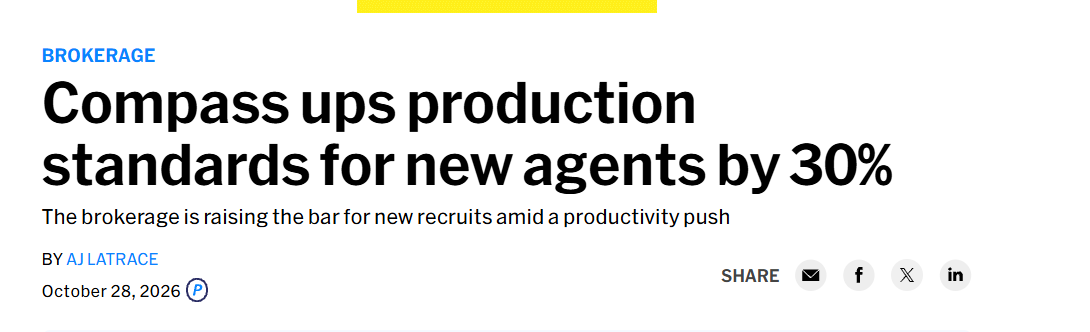
And now comes its latest announcement: Compass is raising minimum production requirements for incoming agents by 30%.
According to HousingWire, Compass President Neda Navab announced the change at the company's annual RETREAT conference on October 28, describing a shift toward agent quality rather than headcount.
Selling a home, or an estate or trust property? See what you would walk away with after costs using my free Seller Net Sheet Calculator.
Sounds impressive.
But I think there's a much more interesting story behind that announcement.
1. Compass Wants More Productive Agents. But Who Is Producing Them?
For years, Compass recruited aggressively, promising agents superior technology, marketing, and support. Now it's changing direction. Rather than emphasizing the recruitment and development of agents at every production level, Compass is raising the minimum production requirement for agents who want to join.
Here's the problem with that strategy.
If you're only interested in recruiting agents who are already productive, where do those agents come from?
Primarily, other brokerages. Someone else helped those agents get started, learn the business, develop clients, and build production. Compass can then recruit the successful ones. There's nothing illegal about that. Recruiting experienced agents is part of our business. But let's not confuse recruiting productive agents with making agents more productive.
And let's not pretend that transferring an agent's existing business from one brokerage to another creates additional transactions for the real estate industry. That's largely a zero-sum competition for existing production. Compass may grow its market share. But that doesn't mean the market itself is growing.
2. The 30% Announcement Deserves a Closer Look
Compass says it's raising minimum production requirements by 30%. Thirty percent sounds substantial. But according to Inman, Compass declined to disclose either its existing or new production thresholds. So we don't know the starting point, the actual requirement, or even whether the measurement is based on transactions, sales volume, or commissions. How meaningful is a 30% increase when nobody outside the company knows the numbers?
There's another interesting piece of information.
Inman reported that Compass disclosed 5,041 agent departures in the first quarter of 2026, with 77% of those agents generating $20,000 or less in gross commission income over the preceding year. Another 3,819 agents left in the second quarter, with 72% producing at that level or below. Those figures don't establish why individual agents left. But they do demonstrate a significant change in the company's agent population.
And that matters when measuring productivity.
Suppose a brokerage has 100 agents, including 30 who produce very little. If those 30 leave, average production per remaining agent can rise even if nobody actually sells another house. You haven't necessarily made your agents better. You've changed who you're counting.
That may be a perfectly legitimate business strategy. But it's not proof of better training, better technology, or better service to consumers.
3. Meanwhile, Compass Is Fighting the Organizations That Make Cooperation Work
Here's where I see a larger pattern.
Compass is challenging the cooperative real estate system while building its own increasingly controlled network.
In California, Compass has filed an antitrust lawsuit against California Regional MLS, challenging rules governing the public marketing of listings. CRMLS also sought court protection for its cooperation rules.
Compass has been involved in litigation with Zillow over listing distribution policies.

Compass has also pursued legal disputes involving former industry executives, including Alex Vidal's move to RE/MAX.

Each case has its own legal issues. Compass has the right to bring claims it believes are justified, and the courts will decide their merits.
But the broader strategy deserves scrutiny.
Compass is fighting rules that encourage broad listing distribution while promoting a system in which more properties can be marketed privately within its own network.
That raises a question every seller should ask:
Does limiting exposure to buyers outside one brokerage help me get the highest possible price, or does it help the brokerage keep more of the transaction inside its own system?
Those interests aren't always the same.
4. CRMLS Raised Questions Every Broker Should Consider
In responding to Compass's lawsuit, CRMLS leadership challenged the company's justification for phased, off-MLS marketing.
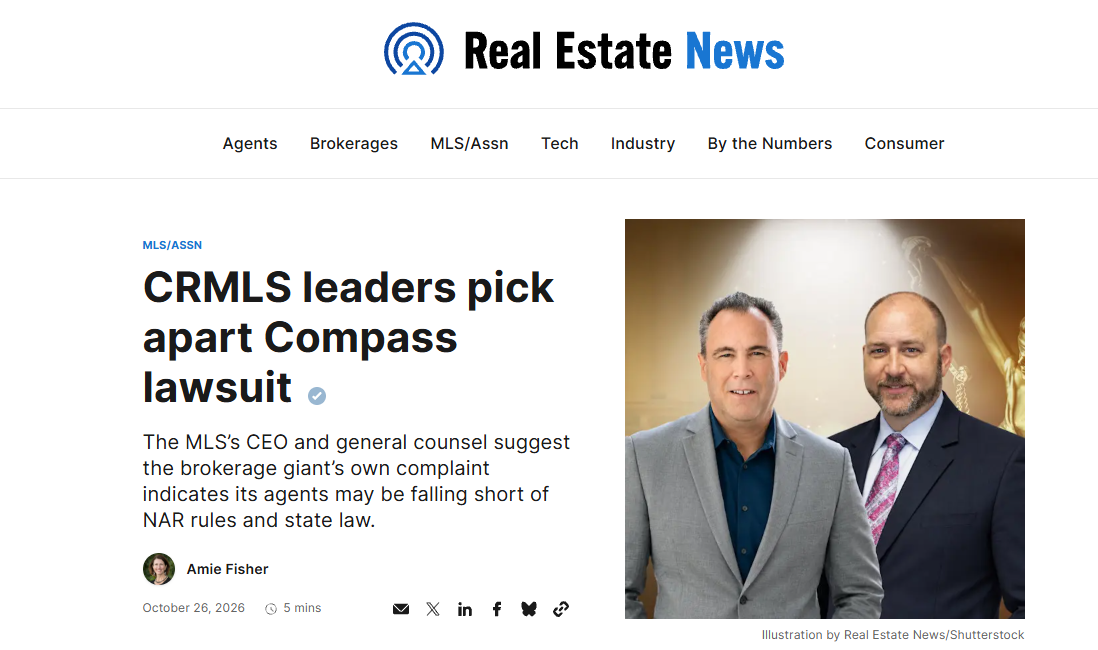
Compass argues that sellers benefit from testing prices privately before exposing their properties to the full market, and from avoiding the negative perceptions associated with price reductions and extended days on market. I have two problems with that argument.
First, isn't determining an appropriate listing price one of the basic responsibilities of a competent real estate broker?
We study comparable sales, market conditions, property condition, and competing listings. Then we advise our clients.
Why should limiting market exposure be the preferred way to determine what a property is worth?
Second, if price reductions and days on market influence how buyers evaluate a property, shouldn't we favor greater transparency rather than making that history harder to see?
Not every private marketing arrangement is inappropriate. Some sellers have legitimate privacy concerns or other reasons to limit exposure.
But those decisions should be made with a clear understanding of the trade-offs, not because a brokerage benefits from keeping listings within its network.
5. A Different Definition of Growth
Look at these developments together.
- Compass is trying to attract more established, productive agents from the existing brokerage population.
- It's challenging MLS rules that can limit its private listing strategy.
- It's fighting Zillow over listing distribution.
- And it's using litigation to defend what it considers its competitive interests.
There's a consistent theme: Compass wants greater control over agents, listings, and how real estate reaches consumers.
That may be a successful corporate strategy. But success for Compass shareholders isn't necessarily the same thing as success for home sellers. If a brokerage recruits 1,000 productive agents from competitors, it has increased its production capacity. It hasn't necessarily created 1,000 better agents. If it moves listings into a private network, it may increase opportunities for its own agents. It hasn't necessarily increased competition for those homes. And if average production rises because lower-producing agents leave, that doesn't establish that its technology or training has improved anyone's performance.
Those are important distinctions.
6. The Fiduciary Standard Is More Important Than the Corporate Standard
I specialize in probate and trust real estate. My clients include attorneys, trustees, executors, and fiduciaries responsible for protecting someone else's financial interests. When we sell an estate property, we need to be able to explain our pricing, marketing, and negotiation decisions. We need a documented process that demonstrates we worked to obtain the best reasonable result for the estate. That's why I believe broad market exposure and transparent marketing records are so important. And that's why I question any business model that makes keeping listings within one brokerage a central part of its strategy.
Compass can set whatever legitimate recruiting standards it wants. It can compete aggressively for agents. And it can challenge MLS rules in court. But let's be clear about what its latest announcement actually means:
Recruiting more successful agents is not the same as developing more successful agents. Increasing average production is not necessarily the same as improving agent performance. And growing a brokerage's market share is not necessarily the same as creating value for consumers.
After 40 years in real estate, my standard hasn't changed.
Show me the data. Show me the marketing. Show me the results.
Most importantly, show me how the client benefits.
Because that's the standard that matters.
Let's take a look at the news from this week.
My weekly overview of the housing market always starts with a look at the key demand and supply factors fundamental in any economy. The driver of demand is interest rates, and supply is measured by the homes for sale.
This week mortgage rates fell slightly, a drop for the 3rd consecutive week, closing at 7.27%, down slightly from last week’s 7.33%.
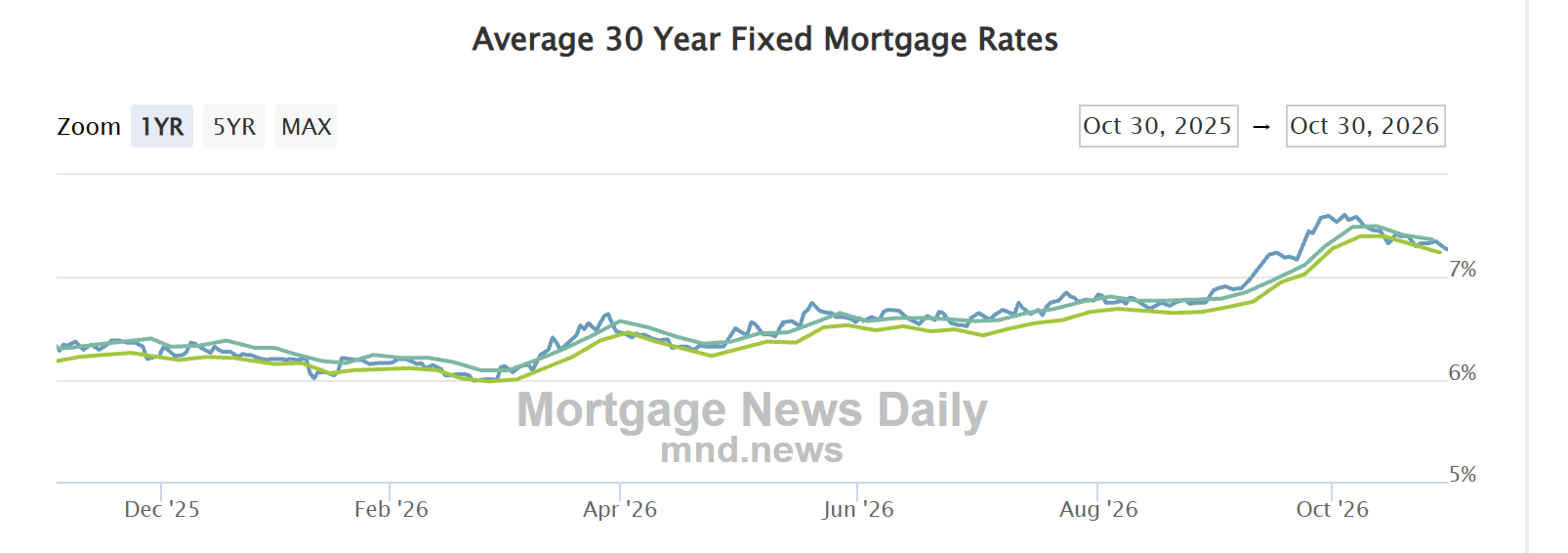
These rates, while causing pain for home builders and 1st time buyers, have not and will not significantly slow purchases as the smaller percentage of the population that can afford to buy a home is doing well.
On the supply side, inventory grew in September to exceed last year's rate by about 3% or almost 21,000 more homes for sale, but down from a 38,000 rise last month.
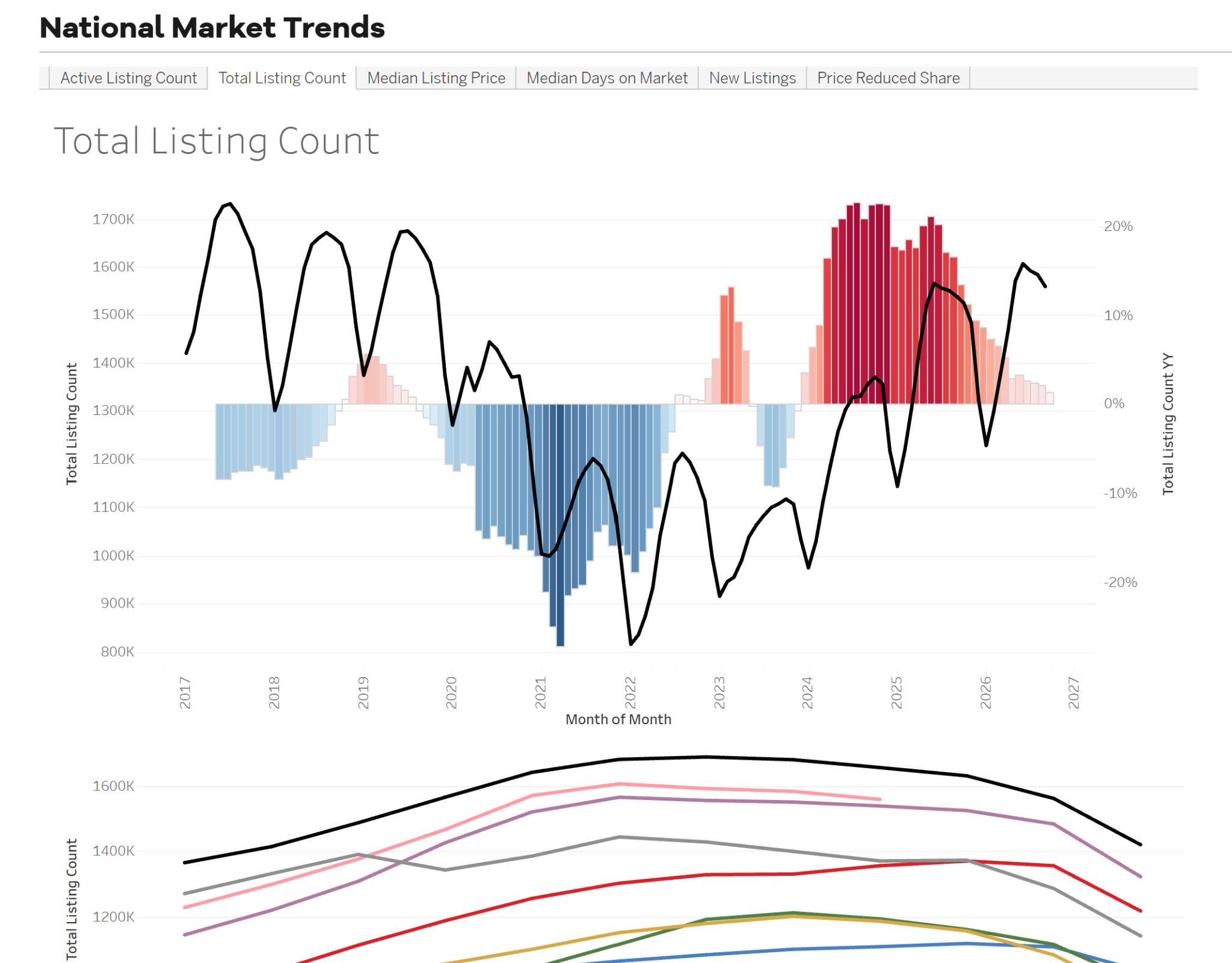
By historical standards, while inventory has increased, it is higher than any COVID year and lower than any pre-COVID year. As long as inventory remains at these levels, housing prices CANNOT substantially decrease nationally, and this creates pressure for more home building.
All real estate markets are locally driven. While there is news nationally, our market is affected by local events and factors. In Los Angeles, our market continues to move slowly towards a balanced market, closing this week again at 34 according to Altos Market Data. This is the closest to balanced the market has been in Los Angeles since before COVID.
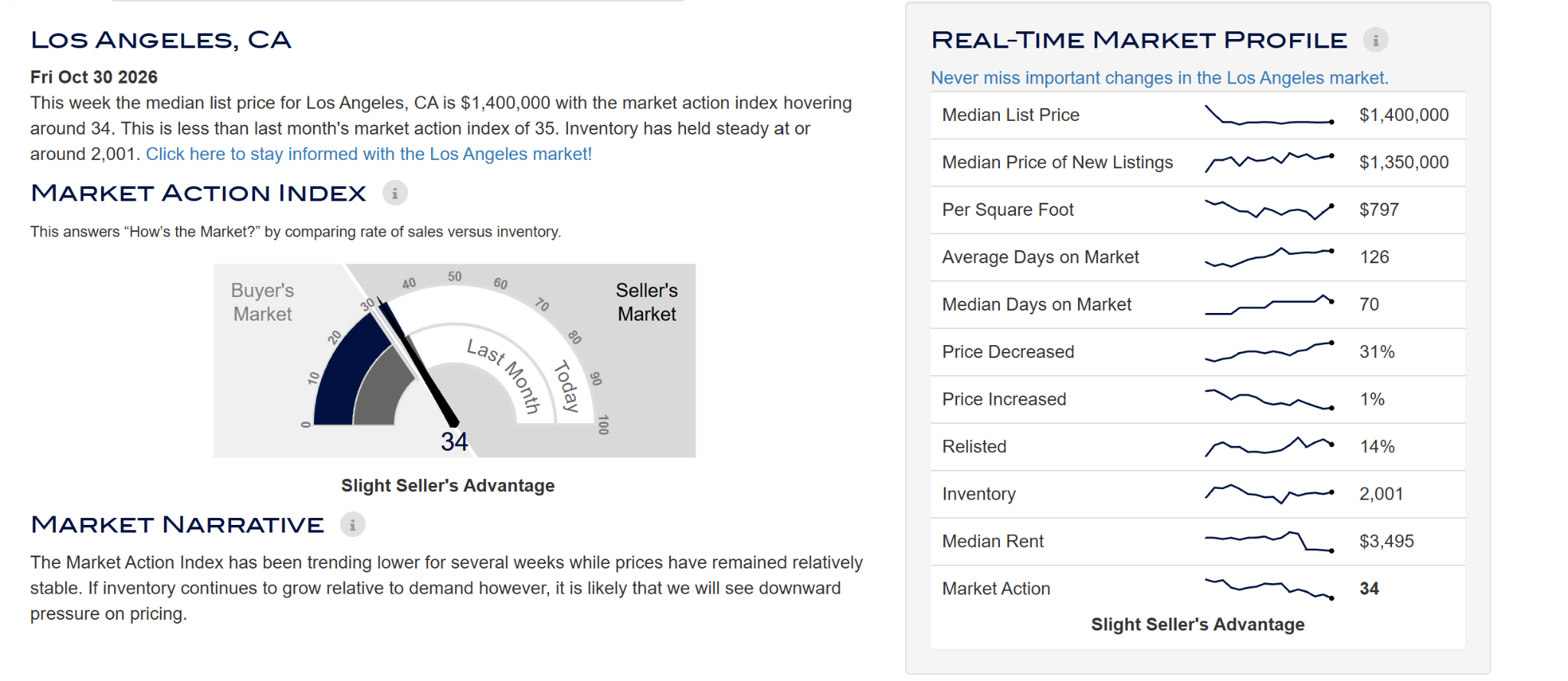
With inventory in Los Angeles growing and price per square foot dropping, this market is finally moving towards a balanced market for buyers just as the interest rates are dropping, making this the best opportunity for buyers in almost a decade.
So, in the news this week…
In news of huge corporations getting caught committing fraud, Zillow settled a claim that they misled shareholders by agreeing to pay $212.5 million, as reported by The Real Deal.
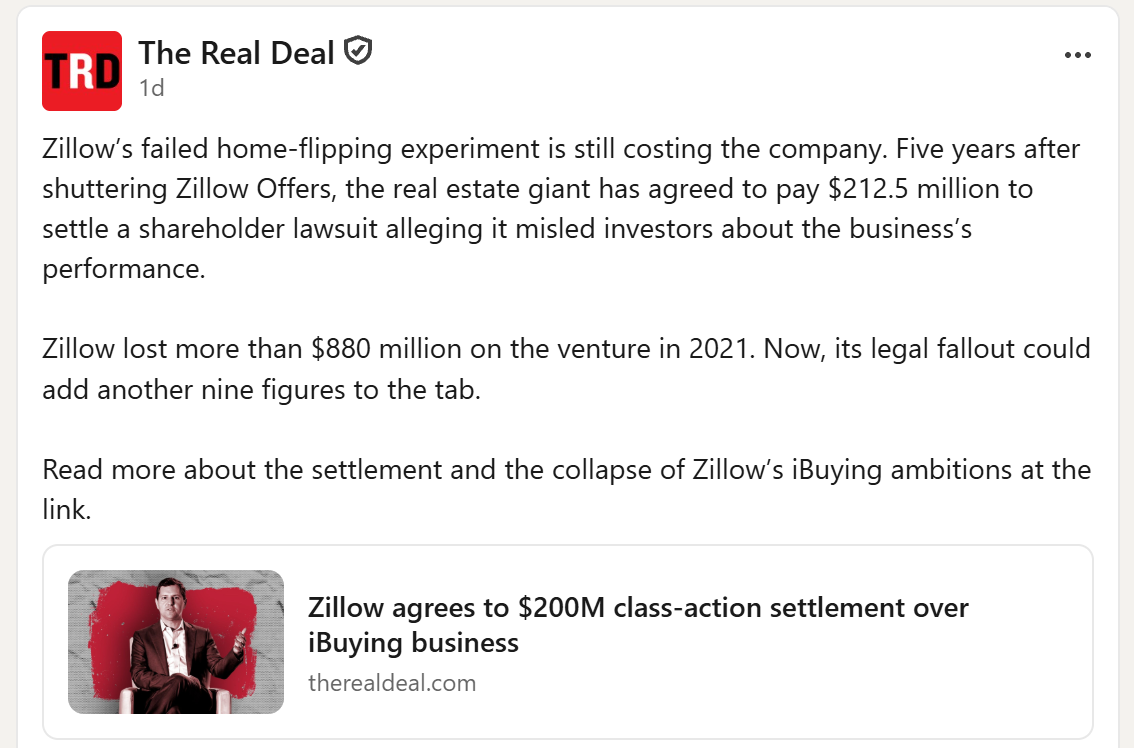
Now, of course they don’t admit the allegations are true, but, really, why else would you pay $212.5 million? So after posting their first EVER profit, for the first time reducing the income tax credits that have helped them avoid paying federal income taxes for over a decade, they actually did NOT make a profit. They lost again. This comes as they continue to destroy a business of small businesses, like me, that pay taxes every year.
Journalism is just part of the propaganda; the Los Angeles Times chronicles the resilience of those attempting to rebuild after the Eaton fire in Altadena, but buries the lede in the emotion of its virtue signaling.

Writing a feel-good story helps hide the facts. So almost 2 years later, how much progress has been made?
- Completed Homes: 233 new homes are finished (up from about 100 homes reported mid-summer on the L.A. County Recovers Dashboard).
- Permits Issued: 3,851 building permits have been issued across the fire zone.
- Under Construction: 2,396 residences are currently being built.
- Uncertain Plots: The status or future plans for roughly 2,000 damaged properties remain unclear.
- Lot Sales: 515 lots have been sold so far, with 44% purchased by developers, private equity investors, or foreign interests.
Heartbreaking. Why does the news not lead with that? This 25-year veteran writer for the Los Angeles Times helps cover up the complete lack of accountability for how a community as wealthy as Southern California can allow this to happen.
In news of a solution that may be worse than the problem, the Los Angeles City Council voted 12–0 at its Wednesday meeting to direct city departments to study the feasibility of establishing designated “entertainment zones” in notoriously violence-prone downtown LA where patrons could carry open containers of alcohol.

Now, the idea of open alcohol areas has been used in entertainment zones, like Culver City and Santa Monica. It's a way to attract business to restaurants and bars. But the plan here is to do the same in the highest crime areas. How bad is the crime in those areas, you ask? Well…
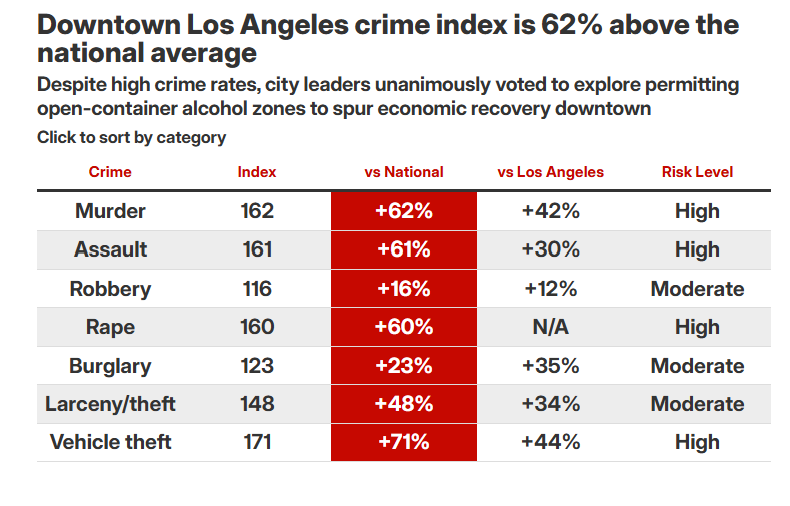
The areas they are proposing have murder rates 62% higher than the national average, with assault, robbery, rape, and other crimes similarly higher. What could possibly go wrong allowing people to carry alcohol in those areas?
So, what should YOU do about buying or selling real estate in today's market?
If you want to move or downsize, it's still a great market to sell, but a bit more challenging than in the last few years.
Finally, if you can find a property that will give you cash flow, this is a great time to get solid cash flow and enjoy the tax benefits of real estate.
How can I help you? Call, text, or email me.
Want to know what your property would net after commissions, escrow, and other costs? Try my free Seller Net Sheet Calculator.
Bill Gross
TheLAProbateExpert.com
(310) 210-0008
bill@thelaprobateexpert.com
Real Estate Broker, DRE #01022275
eXp Realty, 8383 Wilshire Blvd., Suite 800, Beverly Hills CA 90211