The Housing Market Makes No Sense. Unless You're Already Rich.
Prices fall, sellers demand more, buyers disappear—and Wall Street keeps winning. Here's why.

Home Prices Are Falling, Sellers Want More, and Compass Is Celebrating. Welcome to the New Real Estate Economy.
How a broken housing market, Wall Street money, and billions in corporate losses tell the same story.
I saw some interesting statistics this week that aren't supposed to happen at the same time. According to Redfin, the median home sale price has declined 0.4% over the past year, while the median asking price has increased 2%. So sellers want more money, but buyers are paying less?
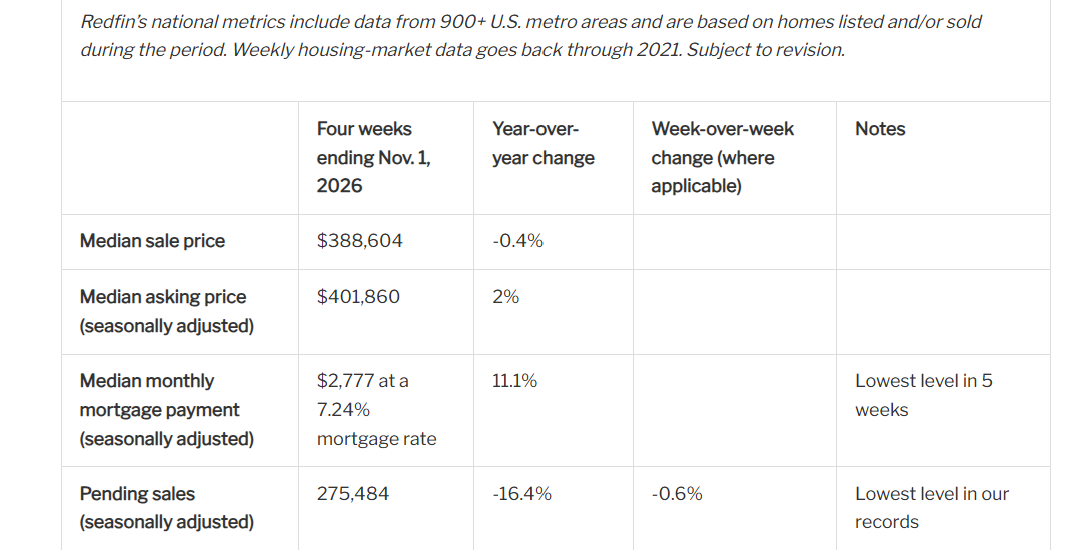
Apparently, somebody forgot to tell sellers that the market has changed. Meanwhile, pending home sales are down 16.4%, even though new listings are down 4.6%. Fewer homes for sale, fewer buyers willing to buy, and sellers still expecting yesterday's prices. Welcome to the 2026 housing market.
What's happening? Buyers are looking at mortgage payments, insurance, taxes, and everyday expenses and saying, "No thanks." Sellers are looking at what their neighbors received three years ago and refusing to accept less. Some homes still sell, particularly to buyers with cash, substantial equity, or high incomes. But increasingly, the people who already own assets have options, while those trying to acquire them have fewer and fewer. That's been the underlying story of our housing market for much of the past decade.
Interest Rates, Jobs, and the Economy That Doesn't Follow the Rules
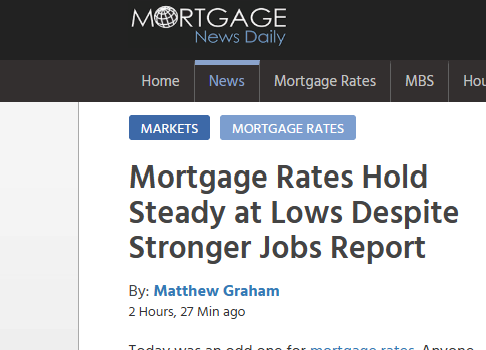
Here's another apparent contradiction. Interest rates recently declined even as economic reports suggested a stronger labor market. For years, we've been told the Federal Reserve must choose between controlling inflation and encouraging employment. Yet rates can fall while employment strengthens? That in fact happened last week and month, where rates have come down AND the jobs numbers continue to improve.
How does that work? Because interest rates respond to much more than the Fed, including bond markets, energy prices, geopolitical risks, and expectations about future inflation. The Middle East conflict has added uncertainty to oil prices and financial markets. As those expectations change, rates can move in directions that don't fit the conventional narrative. Which raises an interesting question: If financial markets can anticipate changing conditions, why does the Fed sometimes seem to be fighting yesterday's economic battle?
Increasingly, our economy is becoming a story of haves and have-nots. Those with substantial assets can earn more on their cash, invest during downturns, and acquire properties or businesses from people who can't afford to wait. Those without assets face higher borrowing costs and declining affordability. The wealthy don't necessarily get richer because they're smarter. Sometimes they get richer because they can afford to wait while everyone else can't.
And that brings me to one of my favorite corporate targets: Wall Street's favorite real estate nepo-baby, Compass.
Compass Finally Makes Money. Break Out the Champagne. Or Maybe a Calculator.
Compass recently announced approximately \$3.9 billion in quarterly revenue and \$62 million in net income attributable to Compass.
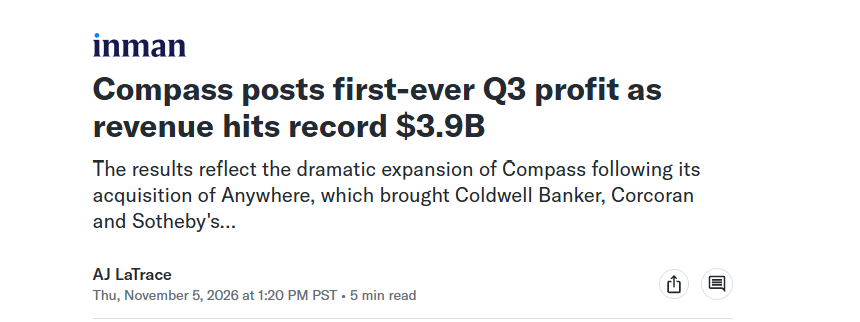
That's its third consecutive profitable quarter, so congratulations! But let's do the math. That's a net profit margin of approximately 1.6%. For every \$100 in revenue, Compass kept about \$1.60. Not exactly a financial miracle, although brokerage has always been a low-margin business. The more interesting question isn't what Compass earned this quarter, but how it has managed to grow so aggressively while accumulating billions in losses.
Compass ended 2025 with an accumulated deficit of approximately \$2.7 billion, which declined to about \$2.5 billion by September 2026.
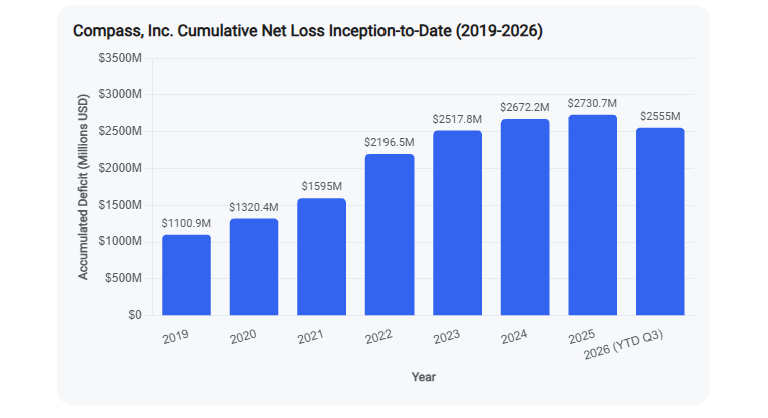
Yet the company reported \$841 million in cash at the end of the third quarter.
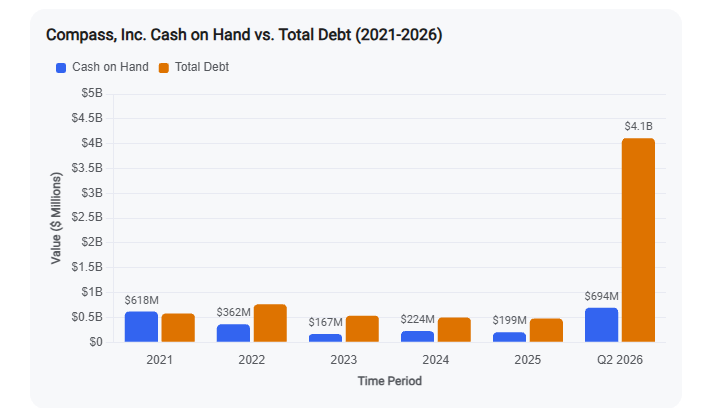
How do you accumulate billions in accounting losses and still have hundreds of millions in the bank? Welcome to Wall Street. Companies can raise capital, issue stock, borrow money, and acquire competitors while operating under financial conditions that most independent brokerage owners can only dream about. And historical losses may provide future tax benefits through net operating loss carryforwards, although those benefits are subject to limitations and aren't the same as the company's accumulated accounting deficit.
Now, I don't begrudge Compass using the tax code or capital markets legally. I'm sure it employs excellent accountants and attorneys to maximize every available advantage. But consider the contrast. An independent brokerage owner who loses money year after year eventually has to close the doors. Compass has been able to continue expanding, acquiring competitors, and financing expensive legal battles while carrying an enormous accumulated deficit. That's a financial playing field tilted heavily toward those with access to Wall Street capital.
Compass Has the Money. Apparently, It Also Has Plenty of Lawyers.
You might think a company that has benefited so enormously from American capital markets and an industry built on cooperation would show some appreciation for the system that made its success possible. Instead, Compass has been fighting what seems like half the real estate industry: competitors, Zillow, MLS organizations, and former employees. Its executives will argue they're defending their business model, protecting agents, and fighting for consumer choice. Fine. That's their argument. Mine is that using enormous financial resources to challenge the cooperative systems that built our industry isn't necessarily good for consumers, agents, or the future of real estate.
For decades, real estate brokerage has depended on competitors cooperating to market properties and serve clients. We compete for listings, buyers, and agents, but we cooperate to get transactions completed. That cooperation is a strength, not a weakness. Compass seems increasingly determined to replace that tradition with litigation, corporate consolidation, and greater control over how listings are marketed and distributed.
And here's where everything connects. A homeowner with substantial equity can wait for the right buyer, while a struggling buyer can't afford today's payments. A corporation with access to Wall Street financing can absorb years of losses and acquire competitors, while an independent brokerage struggling to make payroll cannot. In both cases, those who already have financial resources enjoy advantages that those without them simply cannot match.
Being the Biggest Doesn't Make You the Best
Compass has every right to compete, make money, acquire businesses, and pursue legitimate legal claims. But having the legal right to do something doesn't automatically make it good for the industry. I believe a company that has benefited from extraordinary financial opportunities should recognize some responsibility to the real estate professionals and cooperative institutions that helped make its success possible.
Instead, Compass seems determined to fight anyone who stands in the way of its preferred business model. Maybe Wall Street loves that approach. Maybe shareholders will ultimately be rewarded. But those of us who actually work with buyers, sellers, attorneys, fiduciaries, and families understand something that doesn't always appear on a corporate balance sheet.
Real estate is a relationship business, not a corporate demolition derby.
And if Compass wants to be the biggest company in the industry, perhaps it should spend a little more time demonstrating why it deserves to be its leader.
Because being the biggest doesn't automatically make you the best. Sometimes it just means you have the most money to spend fighting everyone else.
Let's take a look at the news from this week.
My weekly overview of the housing market always starts with a look at the key demand and supply factors fundamental in any economy. The driver of demand is interest rates, and supply is measured by the homes for sale.
This week mortgage rates fell slightly, a drop for the 4th consecutive week, closing at 7.17%, down slightly from last week’s 7.27%.
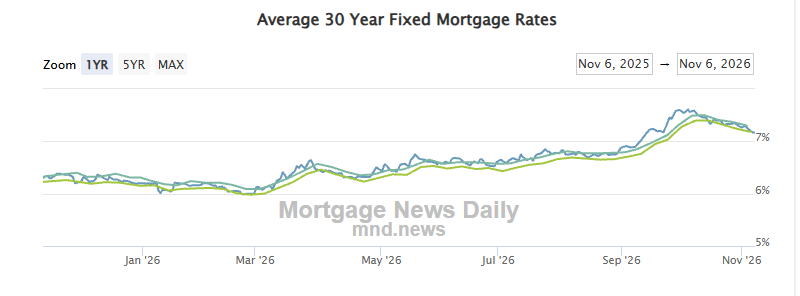
These rates, while causing pain for home builders and 1st time buyers, have not and will not significantly slow purchases as the smaller percentage of the population that can afford to buy a home is doing well.
On the supply side, inventory grew in October to exceed last year's rate by about 7% or almost 83,000 more homes for sale.
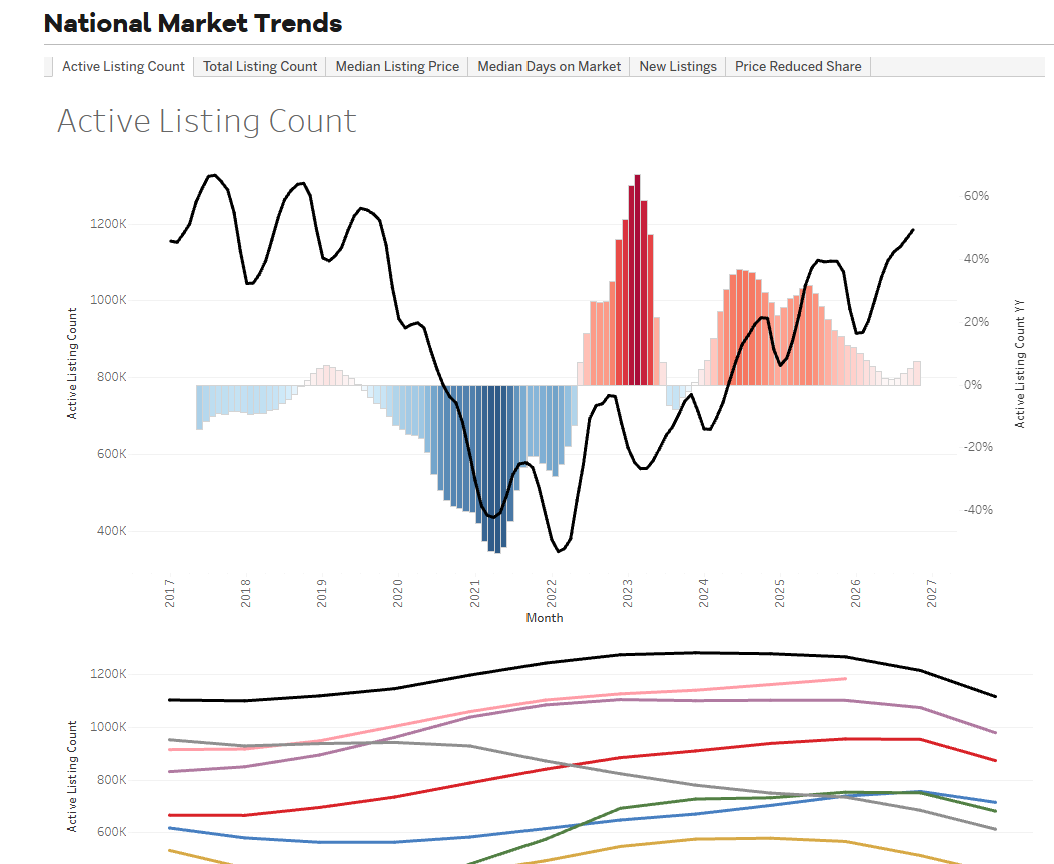
By historical standards, while inventory has increased, it is higher than any COVID year and lower than any pre-COVID year. As long as inventory remains at these levels, housing prices CANNOT substantially decrease nationally, and this creates pressure for more home building.More importantly, this will help stabilize prices so that if rates do continue to drop there will be more homes for sale and reduce price pressure.
All real estate markets are locally driven. While there is news nationally, our market is affected by local events and factors. In Los Angeles, our market continues to move slowly towards a balanced market, closing this week again at 34 according to Altos Market Data. This is the closest to balanced the market has been in Los Angeles since before COVID.
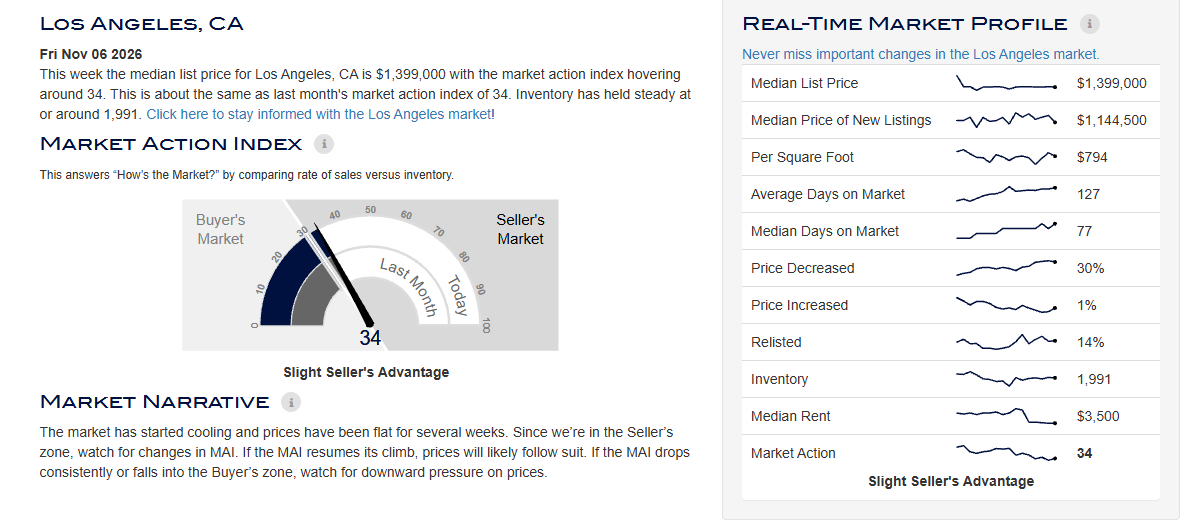
With inventory in Los Angeles growing and price per square foot dropping, this market is finally moving towards a balanced market for buyers just as the interest rates are dropping, making this the best opportunity for buyers in almost a decade.
So, in the news this week…
Not to be left out of Wall Street giants buying up the market, Zillow announced a new program where they offer the down payment for buyers, covering up to 3.5% for certain FHA loans allowing buyers to pay nothing down.
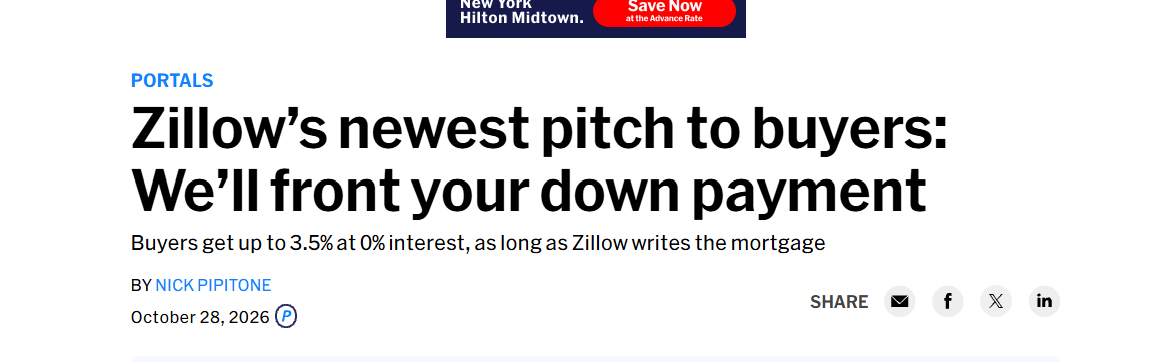
Anyone who lived through the Global Recession of 2008 and 2009 will remember how no down payment loans made the inevitable downfall worse. Here you have Zillow lending the down payment in a market where prices went down about .5% last year. Now if Zillow continues to control more of the buyer’s agent revenue AND makes money by pushing its buyers towards its overpriced captive lending program, they can make more than 3.5% in fees and when the buyer cannot afford the loan the US taxpayer picks up the bill in FHA insurance coverage. While everyone loves down payment assistance, it's the equivalent of handing out candy to kids. They love you, but is it the best policy in the long run to have people buy homes when they have nothing invested in it?
Following up the story I reported last week on a group of 6 multiple listing services getting together to sue Compass, a 7th, MLSListings, joined in the fight to preserve the control of the process at the agent-input local MLS level rather than by a single Wall Street monopoly.
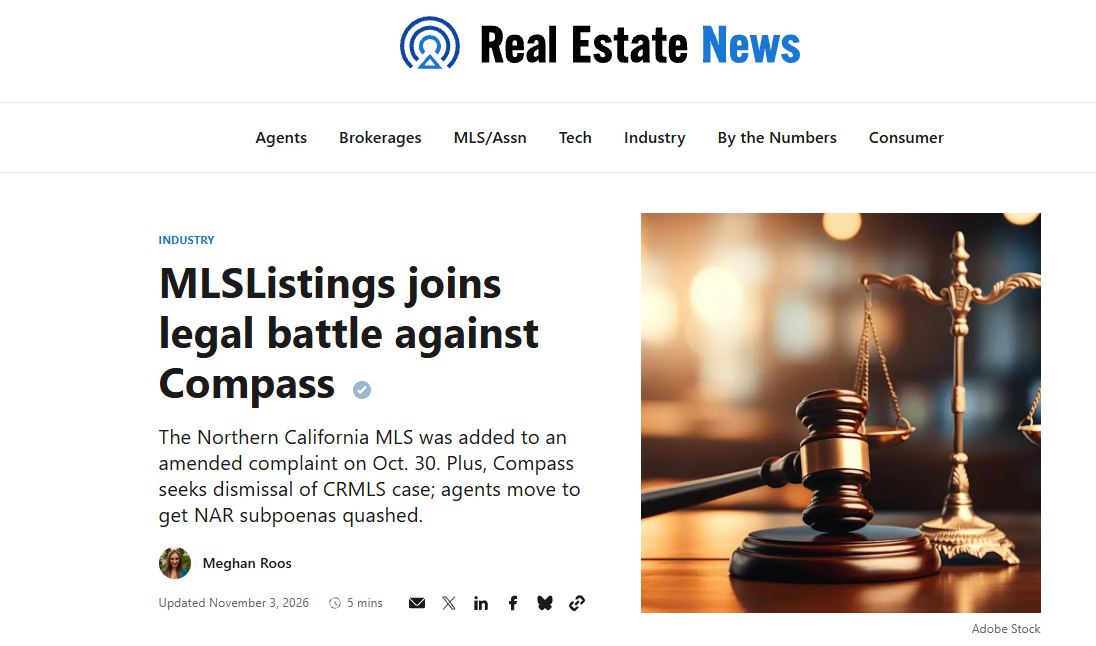
The article also reports that 3 of the most successful agents at Compass are asking a judge to not have to testify in another case Compass has with the National Association of Realtors, and I can understand why. They may need legal representation as witnesses and that can be expensive and time consuming. Perhaps finally after pushing around the industry for years the accumulation of the portion of the industry Compass (along with Zillow) has not yet destroyed will continue to work together and preserve independence for those of us who do not want to work for Compass and who want to give better service to our clients without having to hide listings.
So, what should YOU do about buying or selling real estate in today's market?
If you want to move or downsize, it's still a great market to sell, but a bit more challenging than in the last few years.
Finally, if you can find a property that will give you cash flow, this is a great time to get solid cash flow and enjoy the tax benefits of real estate.
How can I help you? Call, text, or email me.
Bill Gross
310-210-0008
Real Estate Broker, DRE #01022275
eXp Realty, 8383 Wilshire Blvd., Suite 800, Beverly Hills CA 90211